
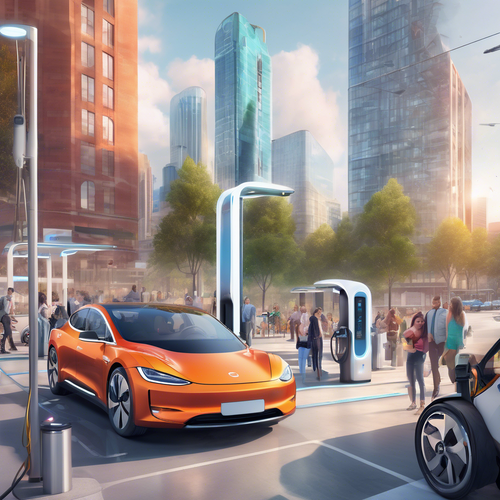
Revel Shuts Down Ride-Hail Business to Focus on EV Charging ⚡️🚗
In a bold pivot that has left industry watchers scratching their heads, Revel announced the termination of its ride-hailing service to concentrate on electric vehicle (EV) charging infrastructure. This decision, as surprising as a cat leaping into a bathtub, seems to encapsulate both the promise and peril of an increasingly electrified future. Could Revel, once a prominent player in the gig economy’s taxi-like tapestry, be trading one turbulent sea for another? 🤔
The ride-hailing sector, once a darling of Silicon Valley, has transformed over the years into a battleground strewn with the debris of companies caught in a web of rising operational costs, regulatory scrutiny, and a labor market hungry for justice. Revel’s retreat from this fray is reminiscent of a soldier trading his sword for a plow—an ironic choice indeed, given the prevailing ethos that tech startups must soldier on through adversity, no matter the odds. Yet here lies a counterpoint: is it not wiser to cultivate a landscape of sustainable growth rather than flounder in the waves of existing business models? 🌱
From Ride-Hailing to Charging Stations: A Strategic Rebirth
Founded in 2019, Revel initially thrived by promoting a fleet of electric scooters, capitalizing on the urban mobility wave. However, as its ride-hailing endeavor floundered amid fierce competition from titans like Uber and Lyft, Revel’s leadership recognized a silver lining; they would redirect their focus to EV charging stations. In a world where gas stations are slowly becoming relics of the past, Revel’s vision seeks to reshape urban landscapes with accessible charging hubs—an ambitious venture that reflects the antithesis of its former model. Will this pivot be a master stroke or a massive misstep? 🔄
An analysis reveals that 2023 marked a pivotal year for the public perception of electric vehicles. According to a recent survey conducted by the International Energy Agency (IEA), public sentiment towards EVs has shifted dramatically, with 61% of respondents considering the transition to EVs an imperative. Just as the ground shifts during an earthquake, consumer demand and regulatory pressure are colliding to create an undeniable push toward green mobility. In this context, Revel’s timing may indeed be auspicious. 📈
The Landscape of EV Charging: Opportunities and Challenges Ahead
Nevertheless, transitioning from a ride-hailing platform to a designated EV charging provider is fraught with complexities. Revel has entered a market where competition abounds and players like ChargePoint, Blink, and Tesla’s Superchargers already dominate the terrain. One may ponder—can Revel, with its relatively nascent brand in this arena, make a tangible impact? This juxtaposition between new entrants and established giants presents a classic David vs. Goliath scenario, dripping with irony since Revel was once Goliath’s shadow in the transportation sphere. 🛡️
Revel’s strategic focus on the expansion of EV charging stations in urban locales is not merely about adding sockets to sidewalk poles. It’s also about addressing infrastructural challenges. Potential users are often deterred by the “range anxiety” that suffocates their willingness to switch gears from gas to electric. Would Revel be the knight in eco-friendly armor to reassure consumers that their electric steeds won’t run dry mid-journey? 🕵️♂️
A Balancing Act: Financial Viability Versus Sustainability
To further complicate the picture, Revel faces the daunting task of balancing profitability with sustainability—a contrast akin to trying to juggle eggs while riding a unicycle. Over the next decade, the U.S. government plans to invest $7.5 billion in EV charging infrastructure, which presents a unique opportunity for companies. Yet, transitioning to a long-term rental model, as Revel proposes, demands significant capital investment and a gradual build-up of customer trust. The irony of needing to ‘plug in’ both financially and socially is palpable within this context. ⚖️
- Regulatory Hurdles: Navigating the labyrinth of city regulations and permits to establish charging stations is no small feat.
- Location, Location, Location: Identifying strategic and accessible sites for chargers is crucial; after all, nobody wants to trek a mile from their car to the charger.
- Consumer Adoption: Even with ample stations, encouraging drivers to overcome charging hesitations remains a central hurdle.
What Lies Ahead: A Future of Electric Roads?
As Revel charts this new course, the question remains: can this once-hit sensation rejuvenate its image and rebuild its business model in a sprawling EV landscape? Just as electric cars promise to revolutionize how we navigate our cities, Revel has the chance to redefine its legacy. Meanwhile, city dwellers and regulators will be watching with bated breath. Is this the dawn of a sustainable transport renaissance or just another expensive detour? 🌅
Ultimately, by pivoting toward EV charging, Revel is vying for a place at the forefront of the sustainable mobility revolution. With the backdrop of global climate change pressing ever harder, there could hardly be a more opportune moment to embrace greener technologies. In evaluating this bold transition, one cannot help but wonder—does this innovative path lead to prosperity or does it hinder on the precipice of uncertainty? 🌍