
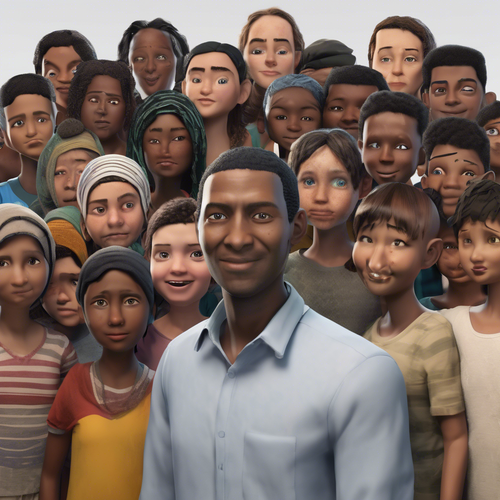
A United Nations Research Institute Created an AI Refugee Avatar 🤖🌍
In a world where the need for empathy often competes with the cold machinations of policy, the United Nations has introduced a groundbreaking innovation: an AI refugee avatar. This initiative, while draped in the shiny veneer of technological progression, raises questions about the authenticity of human experience. Can a digital creation truly embody the plight of millions displaced by conflict and crisis, or does it simply serve to pacify a world increasingly desensitized to human suffering? 🤔
The AI avatar, designed to represent a refugee’s journey, acts as a digital stand-in, weaving together personal stories from a myriad of sources. It is intended to provide a face — albeit a virtual one — to the faceless statistics that typically dominate discussions around migration and asylum. These avatars aim to humanize complex narratives that often feel detached from the realities of individual lives. Ironically, in a bid to make refugee stories more relatable, does the United Nations risk stripping them of their complexity and nuance? 😮
Behind the Code: The Conception of Digital Humanity
The inception of the AI refugee avatar draws on an intriguing paradox: the more technology claims to connect us, the further we seem to drift from genuine human connection. The avatar’s creation involved the collation of numerous testimonies and data sets, forming a digital representation that draws inspiration from real human experiences. This process raises an ethical conundrum: who has the authority to narrate these stories? The stories of displacement are often laden with trauma and have been historically told by outsiders. Can an AI avatar, programmed to mimic emotion and convey experiences, adequately reflect the depth of such lived realities? Like a polished façade, it shines bright but may hide the cracks beneath. 💔
Data from the UN High Commissioner for Refugees (UNHCR) reveals that over 26 million people globally fall into the category of refugees. Each number is a story, often marked by personal loss, resilience, and struggle. Yet, how do you translate grief into code? The irony lies in the fact that while technology allows us to bring these narratives to the forefront, it can also dilute the authenticity of lived experiences, presenting them as consumable content instead of complex human journeys. 📊
The Dual Nature of AI: Advocate and Advocate
The duality of technology serves as both a promising solution and a potential pitfall. Advocates argue that leveraging AI avatars could transform the way communities perceive refugees by drawing attention to their stories rather than just the policies governing their existence. This could lead to greater empathy and understanding amongst populations that may feel disconnected from the refugee crisis. However, this raises the question: can empathy be engineered? Is it fair to expect an avatar, irrespective of how intricately designed, to fulfill the role of a human storyteller? 🤷♂️
Contrastingly, critics posit that an AI avatar could inadvertently contribute to the commodification of suffering. By packaging trauma into digestible bits of narrative, does it risk reducing individuals to mere data points? This tension harkens back to historical dilemmas in journalism and storytelling — the struggle between reporting on suffering versus exploiting it for viewership or engagement. 📰
Real-World Implications: From Virtual to Reality
The potential influence of an AI avatar on public perception is noteworthy. Consider this: if digital representations can evoke compassion and spur action, could they foster a more informed dialogue about migration policies? Will governments be pressured to act more humanely, or could they hide behind the shield of ‘digital advocacy’? Ironically, in the quest for progress, how do we ensure that the urgency of actual refugee lives does not get lost in the glittering allure of digital transformation? 🌟
1. The Challenge of Representation 🧑🤝🧑
As the AI avatar takes center stage, a pressing concern emerges: how accurately does it represent the diverse narratives of refugees? A single digital avatar risks oversimplifying the rich tapestry of experiences encompassing factors such as gender, culture, and socio-economic status. It’s a stark reminder that in representation, less may not always be more; rather, a diverse chorus may be necessary to reflect the symphony that is the refugee experience.
2. Bridging the Gap 🤝
AI avatars could represent an innovative solution to bridge the gap between policymakers and the human stories at the heart of the refugee crisis. As these avatars engage with global audiences, they may foster a deeper understanding of the challenges faced by displaced populations. This could ignite advocacy and encourage individuals to move beyond passive observation to active support, creating a ripple effect in local communities.
Is Technology the Answer? A Philosophical Conundrum
So, as we watch these digital avatars garner attention in policy discussions and humanitarian efforts, we must reflect: does creating an artificial representation solve the very human issues at hand? The thin line between technology as a tool for change and as a method of simplification is a delicate dance. The aim should not simply be to humanize refugees through avatars but to ensure their voices echo loudly and clearly in the discourse landscape. As we advance into a future where technology intertwines with humanity, the question remains — can we use it to enrich genuine empathy rather than replace it? 💭
In this digital era, the challenge lies not in the avatars themselves but in what they represent — a call to prioritize human connection, understanding, and genuine advocacy in discussions that affect millions. After all, as we strive for a more compassionate approach, it’s essential to remember that while technology can foster connections, it is the human stories that resonate the most deeply. ❤️


